Longitudinal hearing data for fluctuating auditory conditions
ENT and audiology decisions in Ménière's disease, cochlear hydrops and related fluctuating hearing disorders are often based on intermittent clinic visits. Vestia provides a longitudinal view of hearing thresholds, symptoms, treatments and relevant events between appointments, presented in a structured report for clinical review.
The gap Vestia addresses
Patients with fluctuating auditory conditions may experience meaningful hearing changes over days or weeks, yet formal audiometry is typically performed only occasionally.
As a result, deterioration, recovery patterns and treatment response may be incompletely captured. Vestia is designed to preserve that timeline, allowing patient-generated longitudinal data to be reviewed alongside formal clinical assessment.
Why longitudinal data matters
Fluctuating auditory conditions are episodic. Thresholds and symptoms can shift over days or weeks, while patients are seen intermittently — so the hearing state at any one consultation may not reflect the course of the condition. Timing, magnitude and recovery are easily lost to recall.
Vestia is designed to preserve that timeline: when symptoms changed, how thresholds moved, what treatments and events coincided, and whether recovery followed. It is intended as observational support for clinical history, not as a diagnostic instrument.
What patients capture
A structured report, not a screenshot
Vestia generates a multi-page PDF the patient brings to consultations: longitudinal hearing trends across 1-month, 3-month, 6-month and full-history views, a medication timeline, threshold change events and return patterns, and a period summary — formatted for review, not as a replacement for formal audiometry. Where it helps, Vestia may assist in summarising longitudinal patterns for the report; it does not provide diagnosis, treatment recommendations or clinical decision-making.
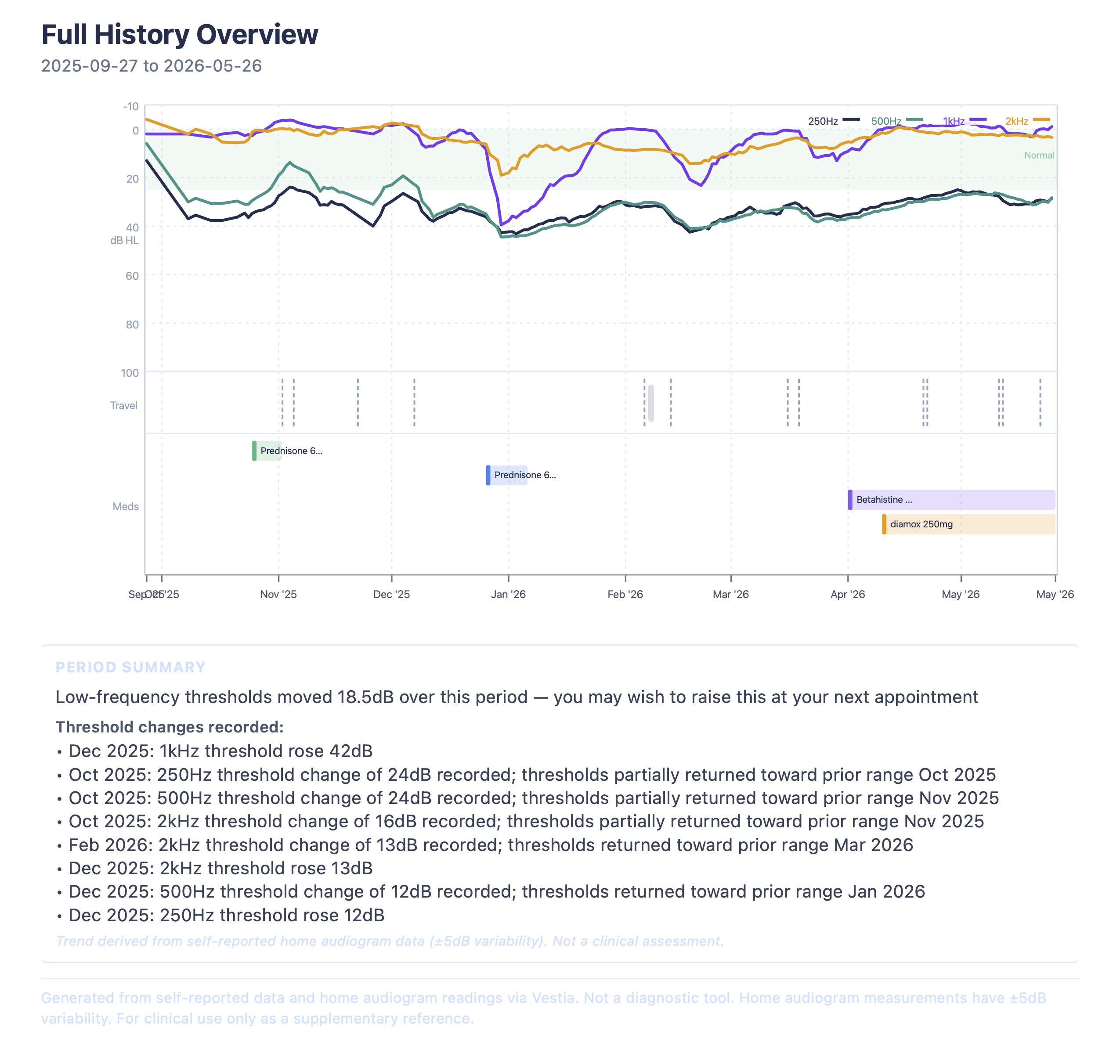
Sample full-history overview. Period-summary and event-level wording is observational — describing what the data shows to surface patterns for discussion, not to determine clinical significance. The report includes 1-month, 3-month, 6-month and full-history views.
Research and validation
Vestia is seeking clinical and academic input on the utility of longitudinal home hearing data in fluctuating auditory conditions — including test–retest reliability, comparison with calibrated audiometry, headphone and device variability, patient adherence, and whether longitudinal tracking improves clinical history between appointments. Clinicians or researchers interested in reviewing the report format, advising on validation, or discussing observational study design can request a sample report or write to hello@vestia.health.
Request sample report
Leave your details and we'll reply personally with a sample PDF and any context you'd like.
What Vestia is and isn't
Vestia is an observational tracking tool for patient-generated longitudinal hearing and symptom data. It is not a diagnostic device, does not replace calibrated clinical audiometry, and does not provide treatment guidance. Home audiogram measurements vary by device, headphones, environment and user behaviour (±5 dB). Vestia reports should be treated as supplementary patient-generated context for clinical review.
About the founder
Vestia was built by David McAvinue, a patient with cochlear hydrops. After finding that the existing standard of care didn't capture what was happening between appointments, David built a tool to track his own hearing fluctuations longitudinally.
Vestia is currently in early iOS beta. The product is being developed in dialogue with the patient community and is seeking input from clinical specialists.
Get in touch
If you'd like to see the app, review the ENT report, or share feedback on clinical utility, please get in touch.
hello@vestia.health